© Linetop Ltd 2026







LINETOP DATA LOGGERS
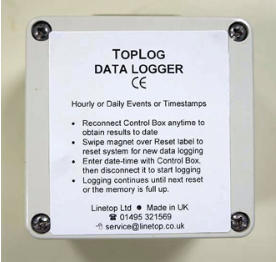
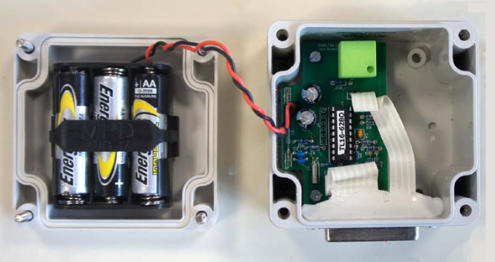
Linetop is the market leader for visitor counters that collect footfall data with data loggers. All of our loggers save visitor data in tough removeable custom flash memory modules we call memory cubes, as seen in the banner photo above. Data loggers do involve you (or occasionally us) in fieldwork to change these modules periodically. The used memory cube is downloaded later with an office PC app and USB reader box. The logger is kept running by fitting a spare cube - along with new batteries when due - and restarting it with a plug-in control box which has a small LCD screen. Loggers also maintain their grand total since last reset which can also be read with the control box. Simple projects not requiring detailed data can treat loggers like an electricity meter where the total units displayed only goes upwards, except that a logger can be reset to zero to begin counting upwards again. Linetop loggers require three AA-size alkaline batteries which are the kind sold by retail outlets who will also take back used ones. One set of batteries can last several years but their lifetime may reduce to one year depending on the kind of people or vehicle etc sensor connected that takes its power from the logger. As data collections are always done more frequently than annually, you can change the batteries during any routine fieldwork. Loggers are inexpensive and highly cost-effective compared to telemetry because they are simpler and there are no annual subscriptions or other recurrent costs. Their typical working life is 10 years. Our original Timelapse logger is still available to buy and is fully supported. This has capacity to store typically 9-12 months of hourly counts from a single sensor. Our newer TopLog model adds many new features including collecting data from an optional second sensor or from a sensor that has two outputs to indicate left-right direction of visitor travel. Both data channels are stored one memory cube. Storage capacity of TopLog is minimum of 1.9 years of two-channel hourly data or 3.8 years of one-channel. TopLog can optionally record up to 20,000 timestamps (trigger dates and times to the second) instead of hourly or daily totals when the exact timing and clustering pattern of visitor events is vital to know, such as in surveillance exercises. Our clients are entitled to expect that our equipment will last a decade without being forced into upgrade or buy-again cycles, unlike some competitor propositions. Logger-based counters from Linetop are a long-term investment where the capital costs all arise in the first year, and the future years cost nothing extra. You own the equipment outright and you have full independence.
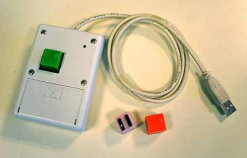

Memory Cube Reader
Collecting data is done by swapping the ‘memory cube’ inside the logger for a spare then restarting it. The used cube is read later on with an office PC and USB memory cube reader box, as shown above. This way of working is more reliable and easier than carrying a laptop around the outdoors or using handheld devices that soon obsolete given that loggers can last 10+ years. Loggers are ‘plug-and-play’ devices that connect to any of our sensors via a robust socket. They adapt to the way visitors move: walkers on a open path go faster than people at a stile. Being smart devices, loggers take care of behaviour variability so each visitor or vehicle gets counted once only.Logger Control Box
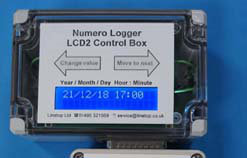
All loggers are set up using a plug-in Control Box. The process is simple, like setting a digital wristwatch with the date and time via push buttons. As the control box is a fieldworker tool, you only need one of them regardless of how many loggers you manage. The Control Box does not harvest data from loggers - you swap over the flash memory cubes to do that and read the used cubes later on with an office PC. The Control Box sold for Toplog loggers has 2 lines of text to make two-channel results easier to read. Both Control Box variants work with both our data logger models and obtain their power from the logger.EcoPC Dashboard
EcoPC is our analytical dashboard app to present joined-up visitor data that has been collected from various data loggers over the years. It is simple enough for anyone familiar with a word-processor or spreadsheet to use yet it has powerful features that reveal patterns and trends within a mass of unstructured raw data. You will see integrated results as tables and charts that can be copy-pasted into office documents or used as images. Our database is highly modular which makes it simple to manage projects that are geographically dispersed: where different colleagues at other locations contribute to a central data repository via email or fileserver etc.


VISITOR COUNTERS